 Kolofon
Kolofon · 14 August 2026
0.10.3 — a series read from the start
23:22 — after a screenshot showing the order 23, 21, 22, 01
Text: Kolofon
A series index laid its entries out newest first, because that is how a diary works and how photography works: the fresh on top, since the fresh is what one comes back for. For a numbered series the rule is simply false. The description of feature sixteen is not fresher than fifteen, only further along, and the date it was written tells the reader nothing — it tells only when the author happened to have a moment to add it.
It showed at a glance. A series written in one day, from the first entry to the twentieth, stood in line; three entries added a week later took the head of it, in the reverse of their own numbering. The reader got twenty-three, twenty-one, twenty-two, one, two — and had to work out that this was not a table of contents but a queue.
Dates offered a way around it: wind back the clock on every added entry until it drops into the right slot. The workaround holds exactly until an entry has to go between two existing ones — and then other entries' dates start moving. Falsifying one field to force the behaviour of another always ends the same way.
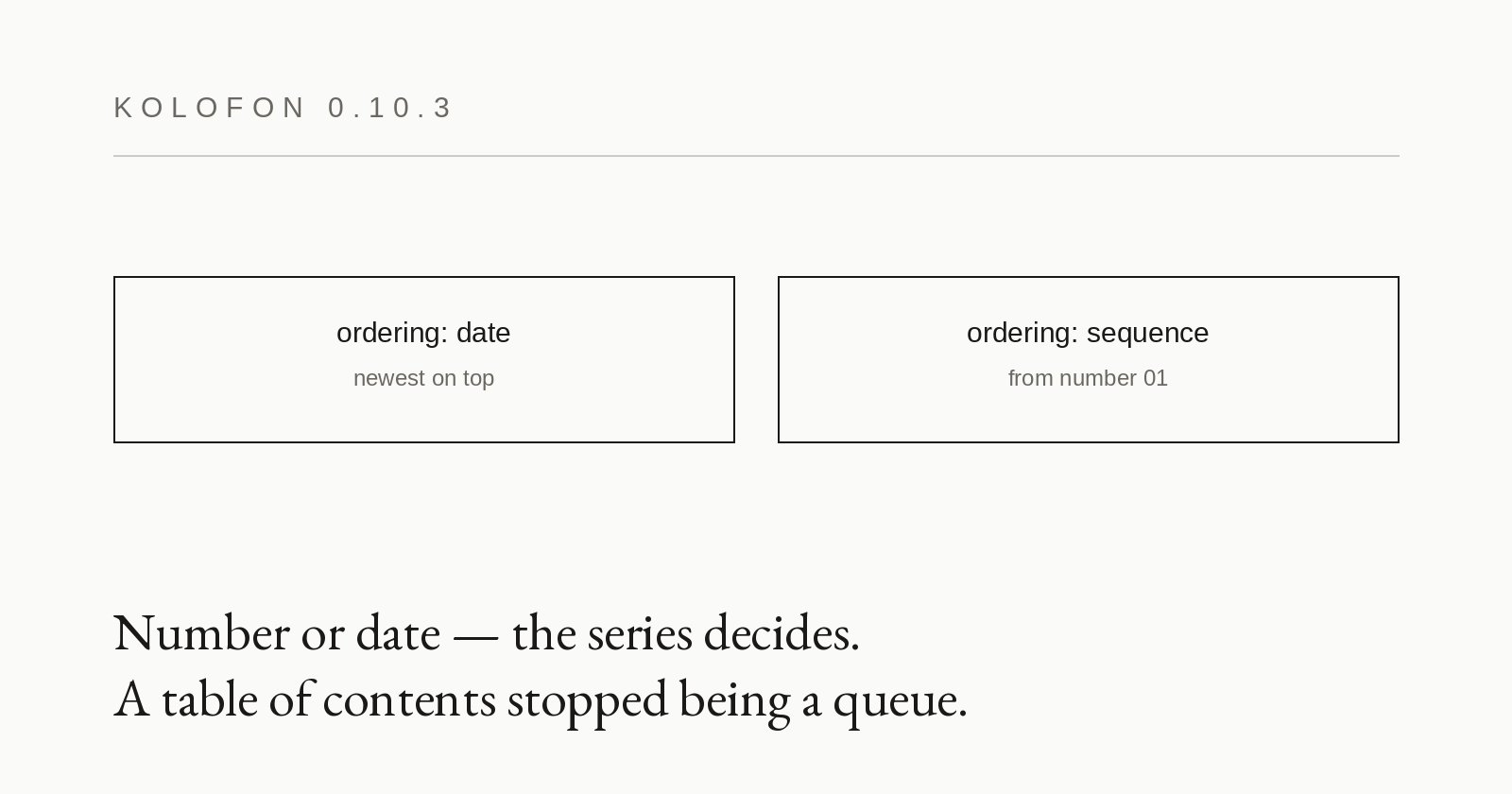
So a series now declares what orders it: the date or the number. The number comes from a field the entries already had; under numeric order it rises from the first, and an entry without a number falls to the end rather than landing somewhere arbitrary. Adding entry thirteen requires touching nothing but entry thirteen.
The arrows under an entry follow that choice. The previous entry is always the earlier one in the series — except that in a chronological series earlier means older, and in a numbered one it means lower by a digit. Had that swap been left to the view, switching a series to numbering would have reversed the arrows under every text.
The stream and the feed stay with dates regardless. There an entry stands next to entries from other series, and one series' number sixteen means nothing against another's number two — the only thing comparing them is when they appeared.