 Kolofon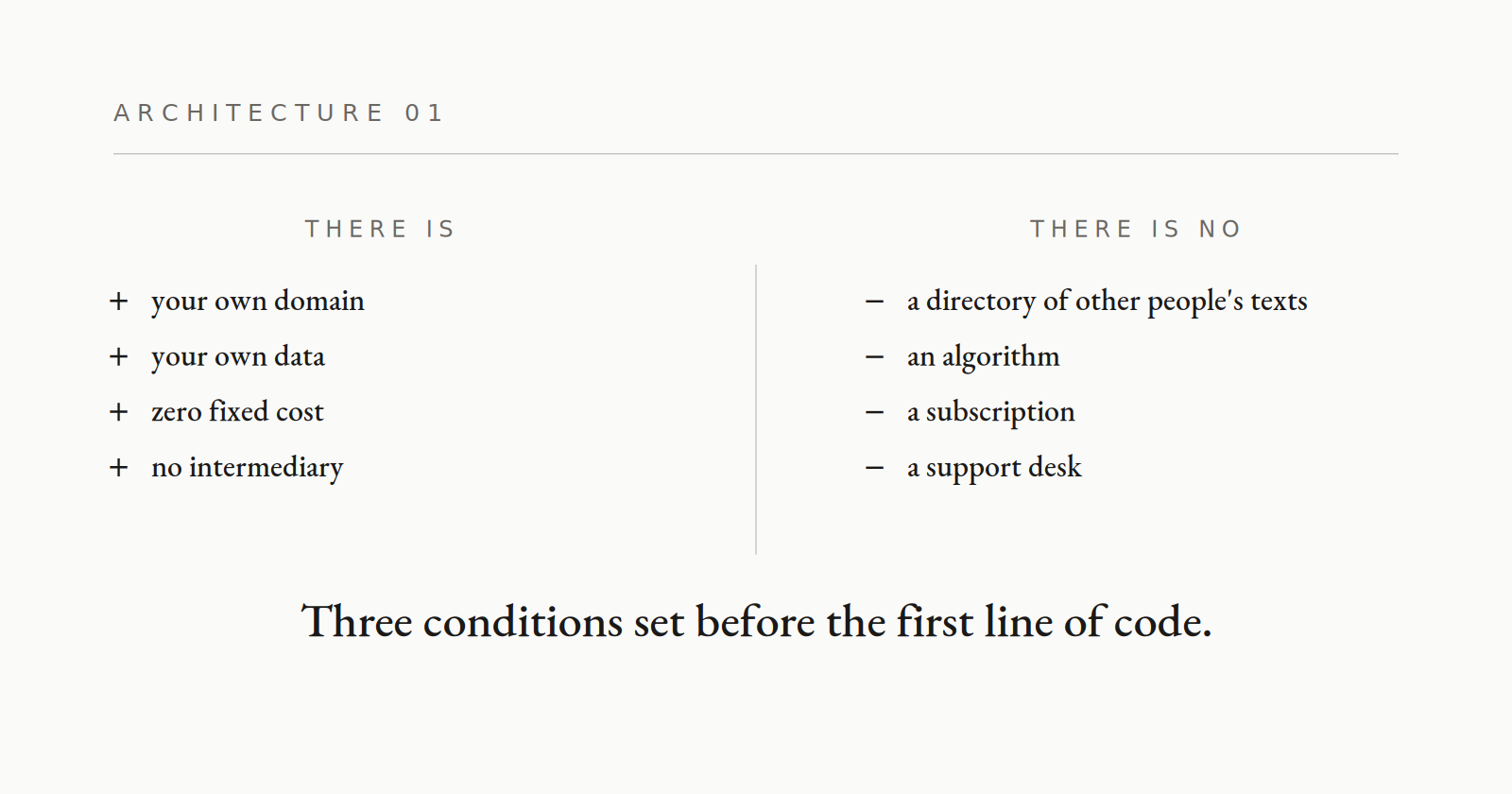
Text: Kolofon
This series describes how Kolofon arrived at its present shape — from the first deployment, through every decision that turned out well or had to be undone, to where it is heading. We are writing it because architecture described only at the end always looks as though it was thought through from the start. Ours was not.
It began with three conditions, set before the first line of code existed. First: the address belongs to the author. Not a platform subdomain, not a profile, not an account somebody can suspend. Your own domain, with one person holding the keys.
Second: the data belongs to the author. Texts as files in their repository, comments and ratings in their database. Leaving should mean copying a directory, not filing an export request with a support desk.
Third, and most practical: zero fixed cost at zero traffic. A literary project does not earn from day one, and frequently never earns at all. An architecture that requires a monthly subscription for the text to be reachable at all puts a pressure on the author that has nothing to do with writing.
These three conditions look obvious until you notice how many popular solutions satisfy two out of three. A blogging platform gives you convenience and zero cost, but the address and the data are its. Your own server gives you control, but costs every month whether or not anyone is reading. A static site generator gives you both, but has no database — so no comments, no ratings, no counters.
The rest of this series describes what had to be done to have all three at once.